A Yellow Rose Project Brings Crowds, Fosters, Community

Meg Griffiths, Subtle fusion of time; archival inkjet print on paper, 16 x 16 inches; Courtesy of the artist.
Good exhibitions bring history to the forefront. Great exhibitions bring history to life with color, dimension, and context. That’s what A Yellow Rose Project accomplishes.
In this Exhibits USA exhibition, more than 100 contemporary female photographers explore the 19th Amendment, which gave women the right to vote. It’s an archive of contemporary thought about a historical moment. With the recent centennial anniversary of women’s right to vote, it’s more relevant than ever.
The yellow rose was a symbol of women’s rights.
Exhibition organizers Meg Griffiths and Frances Jakubek chose the emblem to honor the difficult and ongoing work for representation and political recognition. Their collective project unites communities, visual languages, and histories to facilitate a broader conversation about equity, memory, and agency.
A Yellow Rose Project offers opportunities for both reflection and celebration. And it resonates with viewers of all backgrounds and ages.
A student at Black Hills State University wrote a study of Leticia Huckaby’s Sugar and Spice. A powerful part of the exhibition, the work is a photo of the artist’s daughter, printed on a sack used to collect cotton. The anonymous student wrote:
“Huckaby turns a family portrait into something much bigger: a reflection on how far we’ve come, and how far we still have to go. By printing her daughter’s image on a piece of fabric that holds so much historical weight, she reminds us that these stories—the pain, the hope, the faith—are woven into who we are.”
Through image-making, the artists of A Yellow Rose Project are creating the next chapters in the history of women’s representation in American society. By reflecting on these images, audiences are engaged in that journey—together.

Even during the isolation of the pandemic, the exhibition united people.
“We were honored to exhibit A Yellow Rose Project in 2020,” says Samantha Johnston, executive director and curator of the Colorado Photographic Arts Center. “The exhibition gave our community meaningful ways to connect and talk to one another … the work was so powerful that it created a real sense of connection among visitors.”
It’s an open-ended exhibition that invites viewers to take their time, dig into symbolism, and explore how pieces complement each other or create dissonance. And it speaks to many audiences.
David Johnson is an assistant professor of photography at Coastal Carolina University. His department hosted A Yellow Rose Project in 2024. Classes based in literature, women and gender studies, and political science visited the exhibition. The religion and philosophy departments led a panel discussion about the art. And the gallery space hosted events for university leadership during the exhibit. But for David, it was more than a temporary exhibition.
As cofounder of Print Study for All, he commissioned a portfolio of work from the exhibition to be available to schools in underserved communities, both urban and rural. The selection of photos from A Yellow Rose Project is a great fit for Print Study for All.
“The work asks people to slow down and contemplate what certain things mean,” he says.
Those meanings extend beyond surface-level representation.

“Studies have shown that women receiving the right to vote correlates with a decline in child mortality, an increase in political support and spending for public health, and an increase in educational funding,” says Cat Mueller, Exhibits USA curator of education.
These connections between suffrage, improvements to clean water infrastructure, hygiene campaigns, and the survival of children are all represented in the program guide that accompanies A Yellow Rose Project. These resources help venues build relationships with economic, health, and public affairs communities. These groups can become strong partners that offer unique insights into the exhibition.
Highlighting these profound correlations is just one way organizers support A Yellow Rose Project. They have created a variety of materials to bolster and promote the exhibition across many kinds of spaces. In addition to a press kit and programming guide, the exhibition curators are personally available to answer questions from host galleries. A companion book is available now as well.
This alchemy of arresting visuals, dynamic programming, and curator support has made A Yellow Rose Project a popular and compelling exhibition.
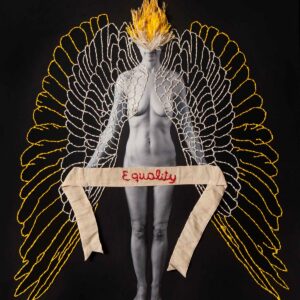
The photos encourage exploration of themes ranging from domestic and economic relationships to the ongoing narratives around women’s rights. A robust programming guide bolsters the exhibition, and the works themselves are accessible to viewers with a variety of interests.
“The exhibition opens up a wealth of opportunities for programming and conversation,” says Samantha. “Meg and Frances have done an incredible job with this project, and they truly want communities to engage with the work and understand its importance.”
“The yellow rose remains a powerful symbol of justice and democracy. Yellow has long carried dual meanings like tenderness and femininity, as well as caution and hazard. In suffrage, it marked women who stood at the edge of safety to have their voices heard.”

View the full gallery and see the exhibition’s tour schedule.