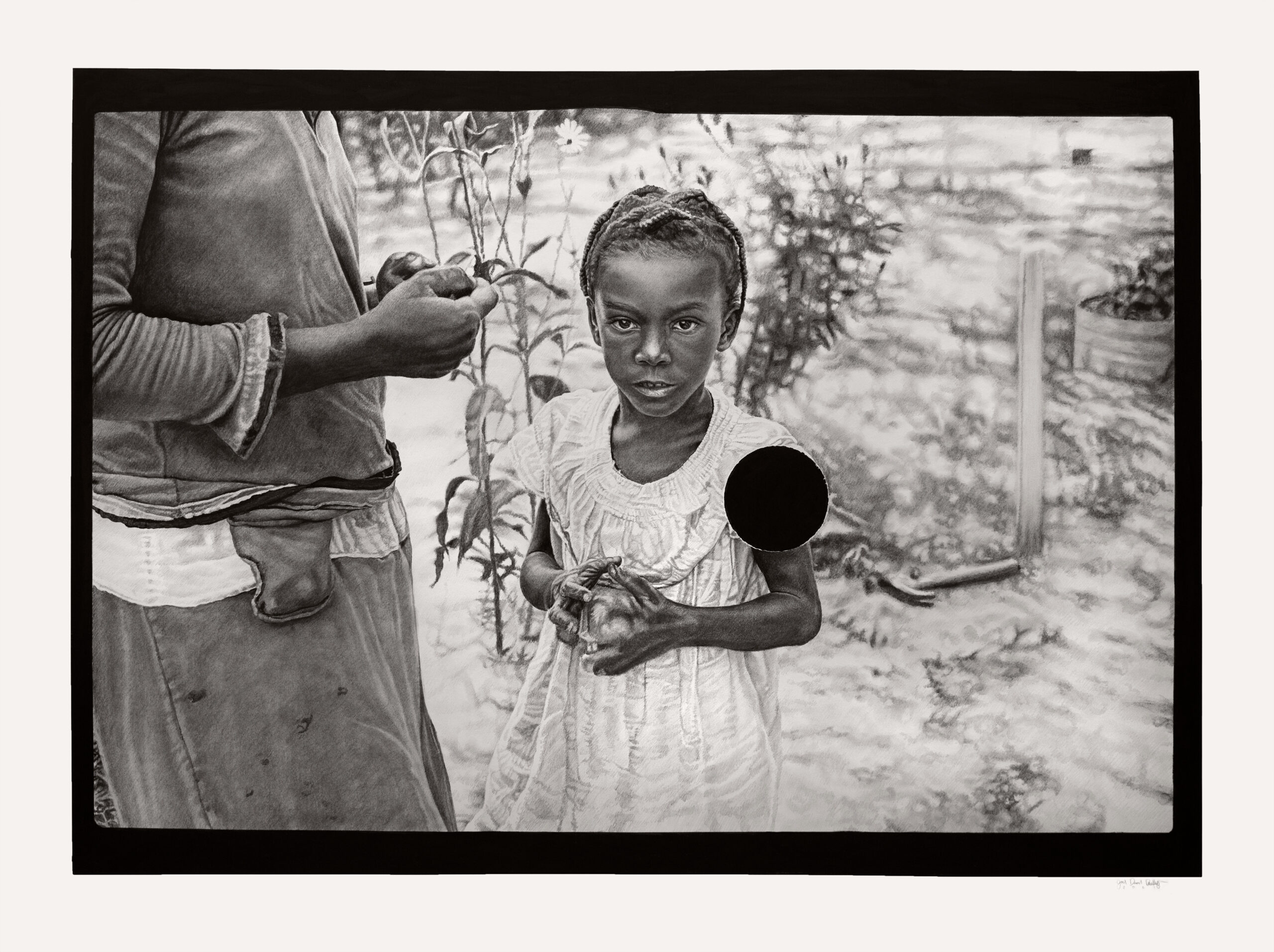
Joel Daniel Phillips, Killed Negative #52 / After Unknown Photographer, 2021; charcoal, graphite and ink on paper, 42 x 56 1/2 inches; Courtesy of the artist.
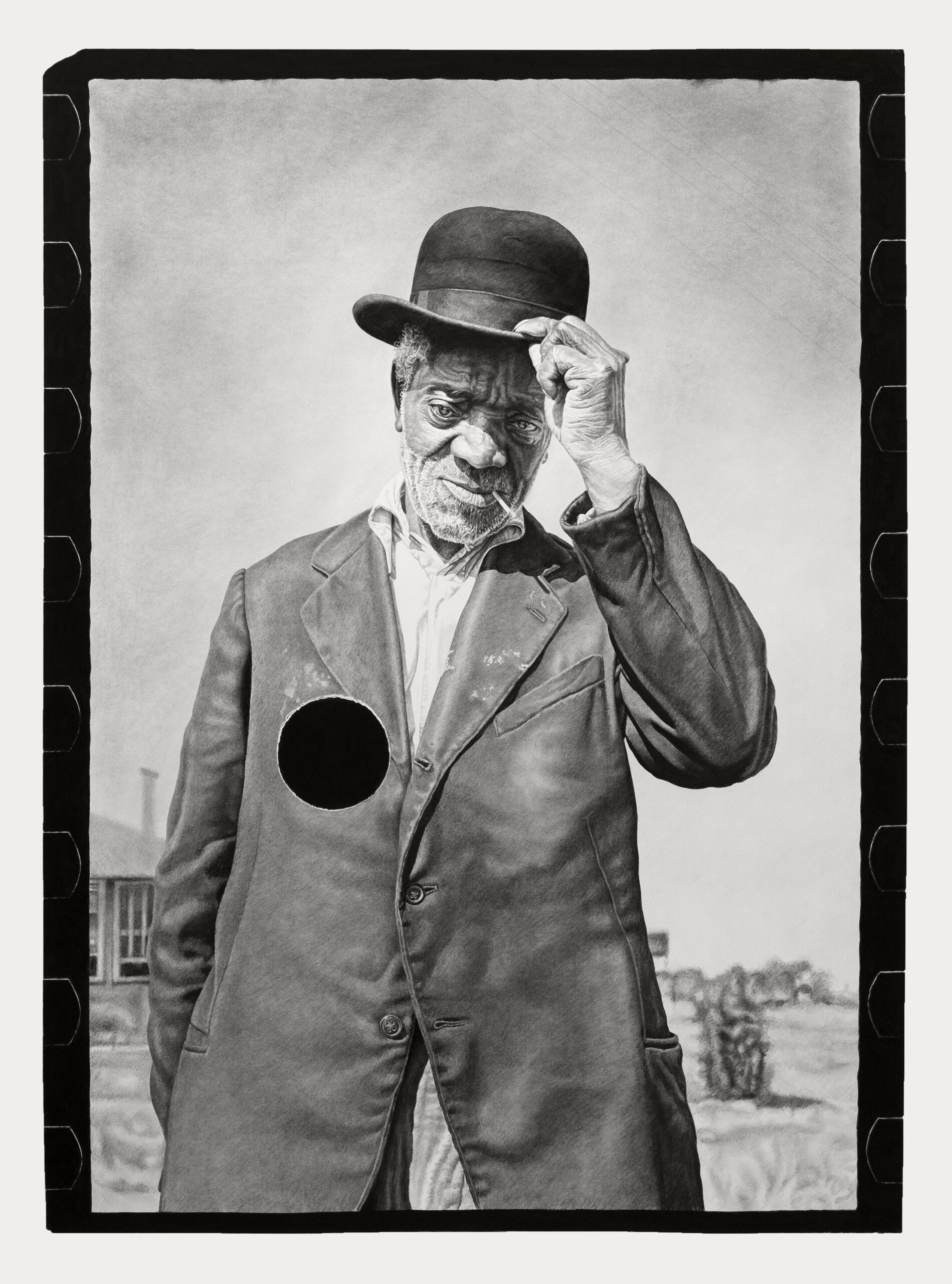
Joel Daniel Phillips, Killed Negative #13 / After Arthur Rothstein, 2020; charcoal, graphite and ink on paper, 56 1/2 x 42 inches; Courtesy of the artist.
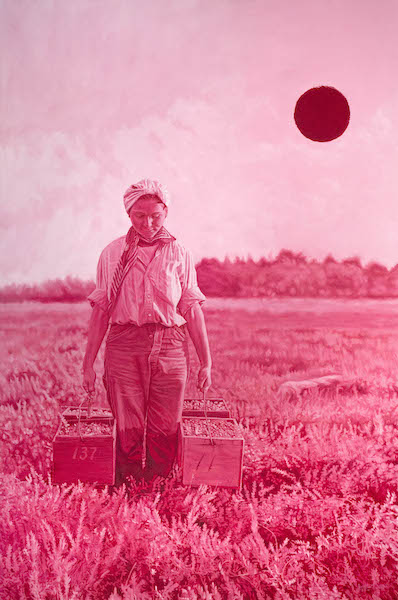
Joel Daniel Phillips, Killed Negative #62 / After Arthur Rothstein, 2021; oil on canvas, 60 x 40 inches; Courtesy of the artist.
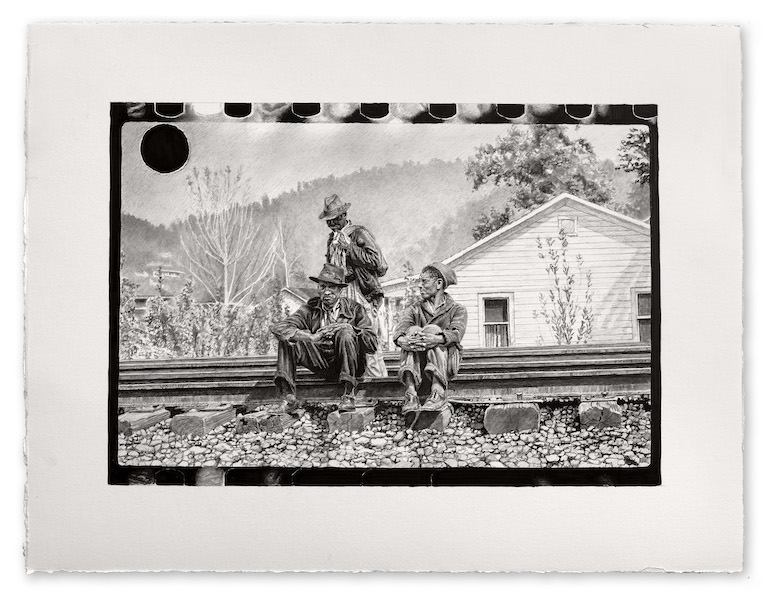
Joel Daniel Phillips, Killed Negative #21 / After Marion Post Wolcott, 2020; charcoal, graphite and ink on paper, 12 x 16 inches; Courtesy of the artist.
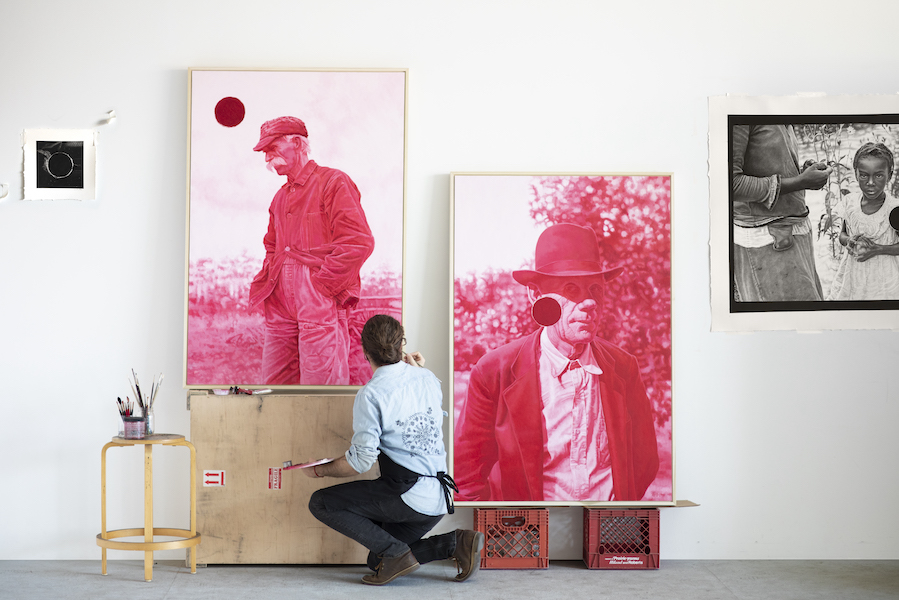
Artist Joel Daniel Phillips working in his Tulsa, Oklahoma studio, Killed Negative #52 / After Unknown Photographer in the upper right. Photograph by Adam Murphy, 2020.
Joel Daniel Phillips, Killed Negative #52 / After Unknown Photographer, 2021; charcoal, graphite and ink on paper, 42 x 56 1/2 inches; Courtesy of the artist.
Killing the Negative: A Conversation in Art & Verse
Large-scale drawings and poems reinterpret Great Depression-era photographs “killed” (punched) by Farm Security Administration editors to explore themes of power, truth, and representation in American history.
While looking through materials on Works Progress Administration (WPA) projects, visual artist Joel Daniel Phillips stumbled upon an image—a 1936 photograph by Walker Evans with a gaping black hole in the center. This chance discovery of a “killed negative” led Phillips and poet Quraysh Ali Lansana into a collaborative project, Killing the Negative: A Conversation in Art & Verse, that explores complex intersections of representation, truth, and power—crucial concepts that are at the center of our contemporary society.
With the stated goal of “introducing America to Americans,” the Farm Security Administration (FSA) commissioned photographers to travel across the United States and document the hardships of the Great Depression between 1935-43. Images like Dust Storm, Cimarron County, Oklahoma (1936) by Arthur Rothstein or Migrant Mother, Nipomo, California (1936) by Dorothea Lange have come to represent the Great Depression in American memory. Roy E. Stryker, who headed the information division of the FSA, screened hundreds of thousands of negatives submitted by the photographers. He wielded his editorial power through an irreversible act—by punching holes in 35mm negatives. Once punched, the images could not be used—whether in popular magazines or in Congressional presentations about the plight of Americans. This destructive editing process was called “killing the negative.”
In this compelling collaborative exhibition, Phillips, Lansana, and a group of noted American poets including US Poet Laureate Joy Harjo, North Carolina Poet Laureate Jaki Shelton Green, Ken Hada, Randall Horton, Rose McLarney, Moheb Soliman, and Candace G. Wiley explore this deeper history, along with complex and timely issues of representation and agency.
Phillips transforms the historic images into large-scale, immersive graphite drawings (meticulously reproduced as giclee prints for exhibition purposes), which urge viewers to confront not just the realism of the image, but also the personal and cultural implications of stories embedded within the image. The poets respond to the image with interventions of text, sound, and breath to give voice to the subject. In each collaboration, poet and artist together fill the vacant space left by government censorship and create an entirely new conversation about power, representation, and the shaping of America’s historical narratives.
In 1938, FSA photographer Arthur Rothstein traveled to Eighty Acres, a segregated community at the edge of Glassboro, New Jersey. He met and photographed an older Black man identified only as an “Agricultural laborer,” and in one of Rothstein’s photographs, the man reaches up as if to tip his bowler hat. Back in his Washington office, Stryker inexplicably chose to censor this image, “killing” it with a sharp, black punch straight through the man’s chest. This image inspired the collaborative pairing of “hospitality” by Lansana and Killed Negative #13 / After Arthur Rothstein by Phillips. The richly toned large drawing fills a wall—the man looks down at and confronts the viewer with both the gentle tip of the hat and the gaping, violent, hole. Lansana’s words–and in the exhibition, his voice–ring out:
what rain must come
for a black man to wet? what sound makes us fall? . . .
you offer no food for my grandsons
mouths. no shelter from raging wind . . . harvest a dream buried in dust
good day, sir
FSA photographers crossed the country to document need in America and build political and popular support for progressive social programs. While the photographs contributed to social reforms, the FSA initiative itself was not entirely open and equitable, and need in our communities is still present. Through these interventions, the poets and Phillips are exploring complex and timely issues that provide catalysts for important conversations about censorship, racism, agency, and equity.
This touring exhibition is an adaptation of the exhibit organized by the Philbrook Art & Gardens in Tulsa, Oklahoma.
About the Lead Artists:
Joel Daniel Phillips is an American artist whose work focuses on the tenets of classical draftsmanship employed in monumental formats. Inspired by the depth and breadth of human experience, he strives to tell the personal and societal histories etched in the world around him. The focus of his work centers on questions of truth, historical amnesia, and the veracity of the stories we tell ourselves about our collective pasts. The drawings are recontextualizations of archival historical material and walk the line between describing a shared, forgotten history and prophesying a terrifying, Orwellian future.
Phillips actively exhibits his work at institutions and galleries across the United States and abroad, including the National Portrait Gallery, Washington, D.C.; Philbrook Art & Gardens, Tulsa, OK; Tacoma Art Museum, Tacoma, WA; Art Museum of South Texas, Corpus Christi, TX; Fort Wayne Museum of Art, Fort Wayne, IN; Gilcrease Museum, Tulsa, OK; and Ackland Art Museum, Chapel Hill, NC, among others. In 2016 he was the 3rd prize recipient in the Outwin Boochever Portrait Competition at the Smithsonian National Portrait Gallery, and he is currently a Fellow at the Tulsa Artist Fellowship in Tulsa, Oklahoma.
Phillips is represented by Hashimoto Contemporary. His works can be found in the public collections of the Smithsonian National Portrait Gallery; Philbrook Art & Gardens; Denver Art Museum; Ackland Art Museum; Urban Nation Museum for Urban Contemporary Art, Berlin, Germany; West Collection, Oaks, PA; Gilcrease Museum; 21c Museum Hotels, Crocker Art Museum, and Fort Wayne Museum of Art.
Quraysh Ali Lansana is the author of twenty books in poetry, nonfiction and children’s literature. Lansana is currently a Tulsa Artist Fellow and serves as Director of the å for Truth, Racial Healing and Transformation at Oklahoma State University-Tulsa, where he is also Lecturer in Africana Studies and English. Lansana is Co-Executive Producer of KOSU/NPR’s Focus: Black Oklahoma monthly radio program, which is a recipient of a 2021 duPont-Columbia Award, a 2021 NAACP Image Award, a 2021 Oklahoma Society of Professional Journalists Award and was nominated for a Peabody Award. Lansana is also the recipient of a 2021 Emmy Award, Oklahoma Association of Broadcasters Award and a 2021 NETA Public Media Award for his roles as host and consultant for the OETA (PBS) documentary film Tulsa Race Massacre: 100 Years Later.
A former faculty member of both the Writing Program of the School of the Art Institute of Chicago and the Drama Division of The Juilliard School, Lansana served as Director of the Gwendolyn Brooks Center for Black Literature and Creative Writing at Chicago State University from 2002-2012 and was Associate Professor of English/Creative Writing there until 2014. His most recent books include Opal’s Greenwood Oasis and the skin of dreams: new and collected poems, 1995-2018. Lansana’s work appears in Best American Poetry 2019. He is a founding member of Tri-City Collective, is a Curatorial Scholar for The Thomas Gilcrease Institute of American History and Art and a Curatorial Board Co-Chair for the Ragdale Foundation.
About the Philbrook Art & Gardens
Philbrook Art & Gardens is committed to being Tulsa’s most welcoming and engaging cultural institution, providing a unique trifecta of experiences: a historic home, world class art museum, 25 acres of gardens. Through bold action and strategic investment, they create a space for new ideas, diverse stories and perspectives, and social connection.
Exhibition Details
22 drawings (in reproduction form) paired with 19 poems (text on panels, with audio/headphones and QR codes for video access)
- Press Kit
- Registrar’s Packet
- Programming Guide
- Gallery Guide
- Text Panels
- Narrative Labels
- Full Insurance
- Installation Instructions
- Custom-Designed and Built Crates
Susan Green
Exhibits USA
Tour Schedule
Killing the Negative: A Conversation in Art & Verse is touring September 2026 through August 2031. The dates below reflect seven-week exhibition periods. Dates are subject to change; please contact MoreArt@maaa.org or (800) 473-3872 x208/209 for current availability.
Supporting Assets
Factsheet
Ready to book?
Contact us to learn more about booking this exhibition for your venue.